

Testosterone replacement therapy, or TRT, has gone from a niche treatment to something advertised on podcasts and social media. Some men genuinely need it. Others are sold it for problems it doesn't fix.
This article sets out who TRT is meant for, what the largest trials show about benefits and risks, and what responsible treatment and monitoring look like.
Who TRT is for
TRT is a treatment for hypogonadism, meaning the body doesn't make enough testosterone. Major guidelines say this should be diagnosed only when a man has symptoms or signs of testosterone deficiency and consistently low testosterone, confirmed with repeated morning blood tests [1, 2]. The American Urological Association (AUA) uses a total testosterone below 300 ng/dL (about 10.4 nmol/L) as a reasonable cut-off [2].
Once deficiency is confirmed, the Endocrine Society recommends looking for the cause and then discussing the potential benefits and risks of therapy, so the man can take part in the decision [1].
TRT is not recommended for men with normal testosterone, or as a general anti-ageing, energy or bodybuilding tool.
Who should not start TRT
The Endocrine Society guideline recommends against starting testosterone in men who [1]:
- are planning to have children in the near term (testosterone can suppress sperm production);
- have breast or prostate cancer, or a prostate nodule that hasn't been evaluated;
- have a PSA above 4 ng/mL, or above 3 ng/mL if they're at higher risk of prostate cancer, without further urological evaluation;
- have a high hematocrit (a measure of red blood cell concentration);
- have untreated severe obstructive sleep apnoea or severe urinary symptoms;
- have uncontrolled heart failure, a heart attack or stroke in the past 6 months, or a blood-clotting disorder (thrombophilia).
Regulators may draw some of these lines differently, which is why the decision belongs with your own doctor (see "The regulatory picture" below).
What the benefits look like
The best-designed early evidence comes from the T Trials, a set of coordinated studies funded by the US National Institutes of Health. They enrolled 790 men aged 65 or older with testosterone below 275 ng/dL and symptoms, and treated them with testosterone gel or placebo for one year [3].
Raising testosterone to the normal range for young men led to:
- a moderate improvement in sexual function, including sexual activity, desire and erectile function;
- slightly better mood and fewer depressive symptoms;
- no significant improvement in vitality (fatigue) and no clear benefit for walking distance in the trial designed to test it [3].
The trial was too small to judge long-term risks [3]. That is where TRAVERSE comes in.
What TRAVERSE showed about the heart
For years, the big question was whether testosterone raised the risk of heart attacks and strokes. The TRAVERSE trial was designed to answer it.
TRAVERSE enrolled 5,246 men aged 45 to 80 who had symptoms of hypogonadism, two fasting testosterone levels below 300 ng/dL, and either existing cardiovascular disease or a high risk of it. They applied a daily testosterone gel or a placebo gel, with a mean follow-up of 33 months [4].
A major cardiovascular event (death from cardiovascular causes, non-fatal heart attack or non-fatal stroke) occurred in 7.0% of the testosterone group and 7.3% of the placebo group. Testosterone met the trial's test for being no worse than placebo [4].
But some other problems were more common with testosterone [4]:
- atrial fibrillation (an irregular heart rhythm): 3.5% vs 2.4%;
- acute kidney injury: 2.3% vs 1.5%;
- pulmonary embolism (a blood clot in the lungs): 0.9% vs 0.5%.
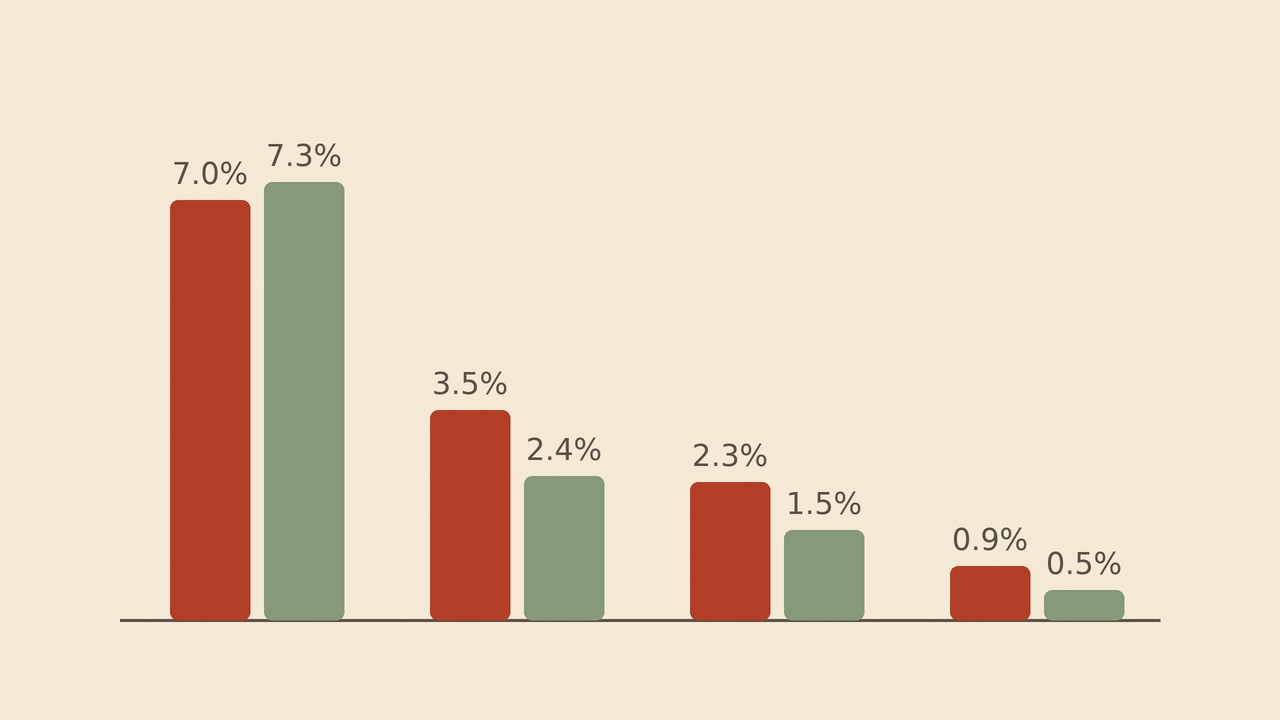
From left to right: major cardiovascular events, atrial fibrillation, acute kidney injury and pulmonary embolism in TRAVERSE. Red bars = testosterone, green bars = placebo [4].
Prostate and bones
In the TRAVERSE prostate analysis, high-grade prostate cancer was rare and not significantly different between groups: 0.19% with testosterone versus 0.12% with placebo. PSA rose more with testosterone [5]. Importantly, men with a PSA above 3 ng/mL or severe urinary symptoms were excluded, so these results apply to carefully screened men [5].
A fracture sub-study brought a surprise. After a median of about 3.2 years, clinical fractures occurred in 3.50% of men on testosterone versus 2.46% on placebo. Testosterone did not lower fracture risk, and the rate was numerically higher [6]. TRT should not be expected to prevent fractures.
The regulatory picture
Rules differ by country. In the United States, the Food and Drug Administration (FDA) required class-wide labeling changes in February 2025: adding the TRAVERSE results, removing the boxed-warning language about cardiovascular outcomes, and adding a warning about increases in blood pressure [7].
In June 2026, the FDA requested further updates to testosterone labeling, including removing the limitation on use in age-related hypogonadism and revising prostate-related warnings. The agency noted that uncertainties remain about long-term prostate cancer risk and that screening and monitoring should continue [8]. Labeling in other countries may differ.
What good monitoring looks like
The Endocrine Society suggests aiming for testosterone in the mid-normal range, not above it, and monitoring men on treatment with a standard plan [1]:
- symptoms, side effects and whether the treatment is being used as prescribed;
- testosterone and hematocrit levels;
- prostate cancer risk, especially in the first year.
The AUA also stresses checking that treatment reaches a therapeutic level and actually improves symptoms [2].
In practice: questions to ask your doctor
- Have my low levels been confirmed with repeated morning tests, and do we know the cause?
- What benefits can I realistically expect, and how will we judge whether it's working?
- Do I want children now or in the future? (Testosterone can reduce sperm production.)
- How will we monitor my blood count, blood pressure and prostate?
- What happens if I stop?
Habits still matter
Whether or not TRT is right for you, sleep, activity and weight still shape how you feel. Viivaa helps you build healthy habits one small step at a time, so progress feels steady and sustainable.
This article is for general information only and isn't medical advice. Talk to your own doctor before starting or stopping any hormone treatment, including testosterone. Don't buy testosterone without a prescription.
References
- Bhasin S, Brito JP, Cunningham GR, et al. Testosterone therapy in men with hypogonadism: an Endocrine Society clinical practice guideline. J Clin Endocrinol Metab. 2018;103(5):1715–1744. https://doi.org/10.1210/jc.2018-00229
- Mulhall JP, Trost LW, Brannigan RE, et al. Evaluation and management of testosterone deficiency: AUA guideline. J Urol. 2018;200(2):423–432. https://doi.org/10.1016/j.juro.2018.03.115
- Snyder PJ, Bhasin S, Cunningham GR, et al. Effects of testosterone treatment in older men. N Engl J Med. 2016;374(7):611–624. https://doi.org/10.1056/NEJMoa1506119
- Lincoff AM, Bhasin S, Flevaris P, et al. Cardiovascular safety of testosterone-replacement therapy. N Engl J Med. 2023;389(2):107–117. https://doi.org/10.1056/NEJMoa2215025
- Bhasin S, Travison TG, Pencina KM, et al. Prostate safety events during testosterone replacement therapy in men with hypogonadism: a randomized clinical trial. JAMA Netw Open. 2023;6(12):e2348692. https://doi.org/10.1001/jamanetworkopen.2023.48692
- Snyder PJ, Bauer DC, Ellenberg SS, et al. Testosterone treatment and fractures in men with hypogonadism. N Engl J Med. 2024;390(3):203–211. https://doi.org/10.1056/NEJMoa2308836
- U.S. Food and Drug Administration. FDA issues class-wide labeling changes for testosterone products. February 28, 2025. https://www.fda.gov/drugs/drug-alerts-and-statements/fda-issues-class-wide-labeling-changes-testosterone-products
- U.S. Department of Health and Human Services. FDA requests updates to testosterone therapy labeling [press release]. June 18, 2026. https://www.hhs.gov/press-room/fda-requests-updates-testosterone-therapy-labeling.html