

Testosterone has a big reputation. It gets blamed for aggression, credited for muscles and sold as the answer to tiredness, low drive and getting older. The real picture is more interesting and a lot less dramatic.
This article explains what testosterone actually does, what a normal level looks like, how it changes with age and how doctors decide whether a level is truly low.
What testosterone does
Testosterone is the main male sex hormone. In men, most of it is made in the testes, and it supports a long list of functions: sexual desire and erections, sperm production, muscle and bone, body hair, red blood cell production, and aspects of energy and mood [1].
It works as part of a control loop. A region of the brain called the hypothalamus signals the pituitary gland, which releases luteinising hormone (LH) and follicle-stimulating hormone (FSH). LH tells the testes to make testosterone; FSH, together with testosterone made inside the testes, supports sperm production. When testosterone levels in the blood are high enough, the brain dials its signals down. When they fall, it turns them up [1].
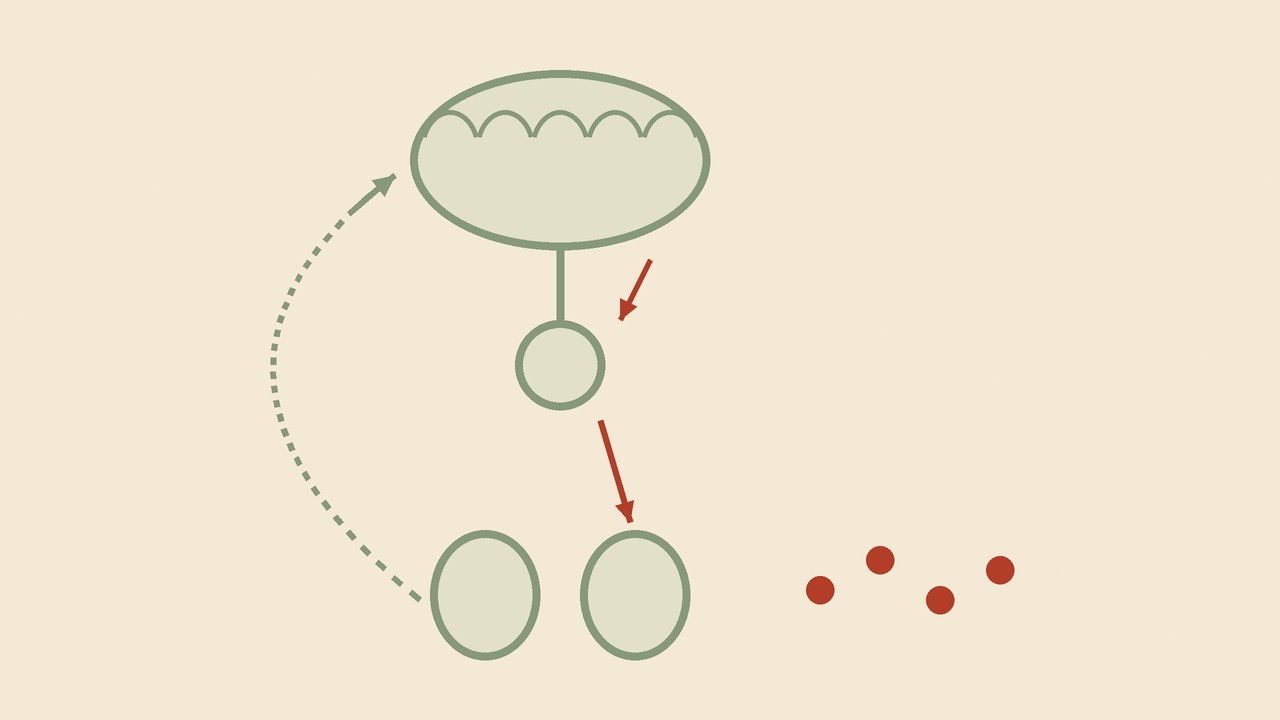
This feedback loop explains a lot. It's why testosterone taken from outside the body can switch off the body's own production, and why doctors check LH alongside testosterone when they look for the cause of a low level [1].
What's a "normal" testosterone level?
Testosterone is usually reported as total testosterone, in nanograms per decilitre (ng/dL) or nanomoles per litre (nmol/L).
The best-known reference range comes from a 2017 study that harmonised measurements from four large cohorts in the United States and Europe, 9,054 men in total. In healthy, non-obese men aged 19 to 39, the normal range ran from 264 to 916 ng/dL (about 9.2 to 31.8 nmol/L), with a middle value of 531 ng/dL (about 18.4 nmol/L) [2].
Clinical guidelines use similar thresholds. The American Urological Association (AUA) considers a total testosterone below 300 ng/dL (about 10.4 nmol/L) a reasonable cut-off for low testosterone [3]. The Endocrine Society recommends using the lower limit of a properly harmonised range, like the one above [1].
Two caveats matter. First, results depend on the laboratory method, which is why the harmonised range was created in the first place [2]. Second, a number alone never makes a diagnosis, as we'll see below.
How testosterone changes with age
Testosterone does tend to fall with age, but slowly. In the Massachusetts Male Aging Study, which followed 1,156 men for 7 to 10 years, total testosterone dropped by about 1.6% per year, and the more active "bioavailable" fraction by 2–3% per year [4].
In the Baltimore Longitudinal Study of Aging, which followed 890 men, the share of men with total testosterone in the range the researchers defined as low rose with age: about 20% of men over 60, 30% over 70 and 50% over 80 [5].
Health matters as much as birthdays. In the Massachusetts study, men in apparently good health, without chronic illness, prescription medicines, obesity or heavy drinking, had androgen levels 10–15% higher than other men [4]. And in the European Male Ageing Study (EMAS), men who lost weight over about four years saw their testosterone rise, while men who gained weight saw it fall [6].
Which symptoms actually point to low testosterone?
Many symptoms blamed on low testosterone, like tiredness, poor sleep, low mood or a softer midsection, are common and have many possible causes.
The EMAS study surveyed 3,369 men aged 40 to 79 in eight European centres and measured their testosterone with a precise method. Several symptoms were linked to lower levels, but only three sexual symptoms clustered together with low testosterone: fewer morning erections, low sexual desire and erectile dysfunction [7].
The researchers proposed that age-related ("late-onset") hypogonadism should be defined by all three of these sexual symptoms together with a total testosterone below 11 nmol/L (about 320 ng/dL) and a low free testosterone [7]. That is a much stricter definition than "feeling tired after 40".
The AUA lists reduced energy, fatigue, low sex drive and erectile changes among the symptoms worth evaluating, but it is clear that symptoms alone are not enough [3].
How low testosterone is properly diagnosed
The major guidelines agree on a few principles [1, 3]:
- Symptoms and a low level are both required. Diagnosis needs symptoms or signs consistent with testosterone deficiency and a low testosterone level. Neither one on its own is enough.
- Test in the morning. Testosterone is highest in the morning, so blood should be drawn early. The Endocrine Society recommends a fasting morning sample [1].
- Repeat the test. One low result should be confirmed with a second morning measurement on a different day [1, 3].
- Look for a cause. If testosterone is confirmed low, the next step is to find out why, which includes measuring LH [1].
- Free testosterone in some cases. When total testosterone is borderline, or a condition affects the protein that carries testosterone in the blood (SHBG), measuring or calculating free testosterone can help [1].
In practice
- If you have symptoms you're worried about, book a visit rather than ordering an online "T test" and interpreting it alone.
- Ask for an early-morning blood test, and expect a repeat if the first result is low.
- Mention your medicines, sleep, alcohol intake and any recent illness or weight change, all of which can affect results.
- Remember that a level at the lower end of normal is still normal.
- Treat the basics as part of the plan: in the large studies above, weight and general health were tied to testosterone levels [4, 6].
Small habits, steady progress
You can't control every hormone, but you can shape the daily habits around sleep, food and movement that support overall health. Viivaa helps you build healthy habits one small step at a time, so progress feels steady and sustainable.
This article is for general information only and isn't medical advice. Talk to your own doctor before starting or stopping any hormone treatment, including testosterone.
References
- Bhasin S, Brito JP, Cunningham GR, et al. Testosterone therapy in men with hypogonadism: an Endocrine Society clinical practice guideline. J Clin Endocrinol Metab. 2018;103(5):1715–1744. https://doi.org/10.1210/jc.2018-00229
- Travison TG, Vesper HW, Orwoll E, et al. Harmonized reference ranges for circulating testosterone levels in men of four cohort studies in the United States and Europe. J Clin Endocrinol Metab. 2017;102(4):1161–1173. https://doi.org/10.1210/jc.2016-2935
- Mulhall JP, Trost LW, Brannigan RE, et al. Evaluation and management of testosterone deficiency: AUA guideline. J Urol. 2018;200(2):423–432. https://doi.org/10.1016/j.juro.2018.03.115
- Feldman HA, Longcope C, Derby CA, et al. Age trends in the level of serum testosterone and other hormones in middle-aged men: longitudinal results from the Massachusetts Male Aging Study. J Clin Endocrinol Metab. 2002;87(2):589–598. https://doi.org/10.1210/jcem.87.2.8201
- Harman SM, Metter EJ, Tobin JD, Pearson J, Blackman MR. Longitudinal effects of aging on serum total and free testosterone levels in healthy men. J Clin Endocrinol Metab. 2001;86(2):724–731. https://doi.org/10.1210/jcem.86.2.7219
- Camacho EM, Huhtaniemi IT, O'Neill TW, et al. Age-associated changes in hypothalamic-pituitary-testicular function in middle-aged and older men are modified by weight change and lifestyle factors: longitudinal results from the European Male Ageing Study. Eur J Endocrinol. 2013;168(3):445–455. https://doi.org/10.1530/EJE-12-0890
- Wu FCW, Tajar A, Beynon JM, et al. Identification of late-onset hypogonadism in middle-aged and elderly men. N Engl J Med. 2010;363(2):123–135. https://doi.org/10.1056/NEJMoa0911101