

It sounds logical: testosterone is the male hormone, so more of it should help a man father a child. In reality, taking testosterone works the opposite way. It can sharply reduce, or even stop, sperm production.
If you're thinking about testosterone therapy, already using it, or have used anabolic steroids, and you'd like children now or later, this is worth understanding before you decide anything.
Why outside testosterone lowers sperm production
Sperm production depends on a signalling loop. The brain's pituitary gland releases two hormones: luteinising hormone (LH), which tells the testes to make testosterone, and follicle-stimulating hormone (FSH). Sperm production needs FSH plus a very high concentration of testosterone inside the testes, much higher than in the blood.
When testosterone comes from outside the body, as a gel, injection or steroid, the brain senses plenty of it in the blood and turns LH and FSH down. The testes then make far less of their own testosterone and far fewer sperm [1, 5].
This effect is strong enough that researchers have tested testosterone as a male contraceptive. In a World Health Organization study, 271 healthy, fertile men received weekly testosterone injections. By six months, 65% had no sperm at all in their semen (azoospermia), on average after about four months of treatment [3]. One study of testosterone replacement therapy (TRT) notes that it can lead to azoospermia in about 40% of men [5].
What the guidelines say
Both major guidelines are direct on this point:
- The American Urological Association and American Society for Reproductive Medicine (AUA/ASRM) male infertility guideline says that, for men interested in current or future fertility, clinicians should not prescribe testosterone [1].
- The Endocrine Society recommends against starting testosterone therapy in men who are planning fertility in the near term [2].
The AUA/ASRM guideline also notes that male factors are the only cause in about 20% of couples with infertility and contribute in another 30–40% [1], so men's hormones and habits are an important part of the picture.
Does sperm production come back after stopping?
Usually, but not instantly, and not always on a predictable timeline.
The best data come from male contraception studies, where healthy men took testosterone-based hormones on purpose and then stopped. In the WHO study, the median time to recover a sperm concentration of at least 20 million per millilitre was 3.7 months, and to return to each man's own baseline it was 6.7 months [3].
A larger analysis pooled 1,549 men from 30 such studies. Recovery to 20 million per millilitre was reached by [4]:
- 67% of men within 6 months;
- 90% within 12 months;
- 96% within 16 months;
- 100% within 24 months.
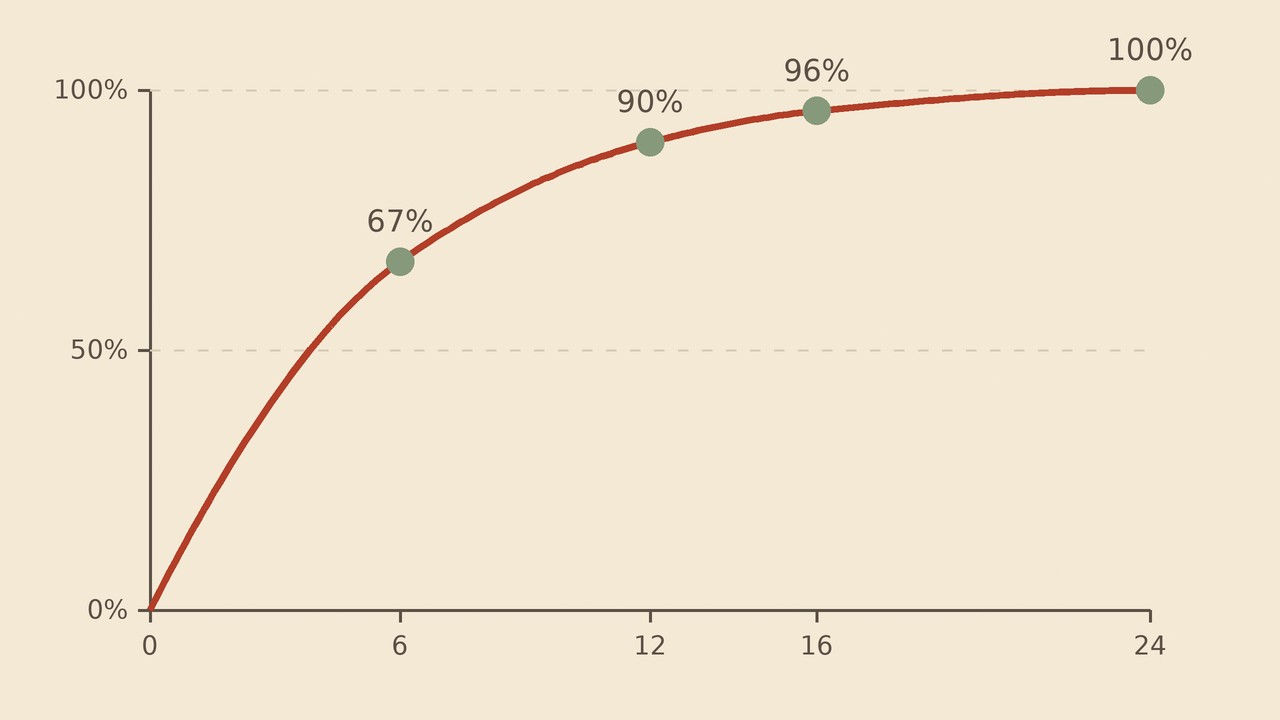
Recovery was slower after longer treatment and with longer-acting testosterone preparations [4].
There's an important caveat. These were healthy volunteers with normal hormones before treatment, using controlled doses for a limited time. Men who had low testosterone to begin with, or who used high doses of steroids for years, may not follow the same curve.
What about anabolic steroids?
Anabolic-androgenic steroids, often taken at doses far above medical ones, suppress the same system. The AUA/ASRM guideline describes current steroid use as having a major impact on sperm production, while noting that low-quality evidence suggests it doesn't usually cause permanent infertility [1].
In an Australian study of 41 current users, 31 past users and 21 non-users, past users had largely recovered: on average, LH recovered in about 11 months and sperm output in about 14 months, with recovery taking between 6 and 18 months. Testicle size often stayed smaller, and longer steroid use was linked to slower sperm recovery [6]. However, a review of steroid withdrawal warns that low testosterone after stopping can persist for months or years and, in some cases, may not fully reverse [7].
Fertility-friendly options to discuss
For men who have low testosterone and want to keep or restore fertility, there are alternatives that work with the body's own signals rather than replacing them. The AUA/ASRM guideline says doctors may use medicines such as aromatase inhibitors, human chorionic gonadotropin (hCG) or selective oestrogen receptor modulators (SERMs), alone or in combination, in infertile men with low testosterone [1]. It rates the evidence as limited (grade C).
Some specialists add low-dose hCG to TRT to support sperm production. In one retrospective study of 26 men treated this way, none developed azoospermia and 9 contributed to a pregnancy during follow-up [5]. That's encouraging, but it is a small study without a comparison group.
What about over-the-counter supplements? The AUA/ASRM guideline says supplements are of questionable use for male infertility, because the evidence is limited [1].
In practice
- If you might want children, tell your doctor before starting testosterone.
- If you're already on TRT and want to conceive, don't simply stop on your own. Ask about a plan that may include a semen analysis and fertility-friendly treatment.
- If you've used steroids, a fertility specialist can check your hormones and semen. Be open about your history: it changes the advice you get.
- Give recovery time. Sperm take roughly three months to develop, and full recovery after hormones can take a year or longer.
Taking care of the basics
Fertility is a team effort, and everyday health habits matter for both partners. Viivaa helps you build healthy habits one small step at a time, so progress feels steady and sustainable.
This article is for general information only and isn't medical advice. Talk to your own doctor before starting or stopping any hormone treatment, and see a fertility specialist if you're trying to conceive.
References
- Brannigan RE, Hermanson L, Kaczmarek J, et al. Updates to male infertility: AUA/ASRM guideline (2024). J Urol. 2024;212(6):789–799. https://doi.org/10.1097/JU.0000000000004180 (unabridged guideline: https://www.auanet.org/documents/Guidelines/PDF/2024%20Guidelines/Male%20Infertility%20Unabridged%20Final.pdf)
- Bhasin S, Brito JP, Cunningham GR, et al. Testosterone therapy in men with hypogonadism: an Endocrine Society clinical practice guideline. J Clin Endocrinol Metab. 2018;103(5):1715–1744. https://doi.org/10.1210/jc.2018-00229
- World Health Organization Task Force on Methods for the Regulation of Male Fertility. Contraceptive efficacy of testosterone-induced azoospermia in normal men. Lancet. 1990;336(8721):955–959. https://doi.org/10.1016/0140-6736(90)92416-F
- Liu PY, Swerdloff RS, Christenson PD, Handelsman DJ, Wang C. Rate, extent, and modifiers of spermatogenic recovery after hormonal male contraception: an integrated analysis. Lancet. 2006;367(9520):1412–1420. https://doi.org/10.1016/S0140-6736(06)68614-5
- Hsieh TC, Pastuszak AW, Hwang K, Lipshultz LI. Concomitant intramuscular human chorionic gonadotropin preserves spermatogenesis in men undergoing testosterone replacement therapy. J Urol. 2013;189(2):647–650. https://doi.org/10.1016/j.juro.2012.09.043
- Shankara-Narayana N, Yu C, Savkovic S, et al. Rate and extent of recovery from reproductive and cardiac dysfunction due to androgen abuse in men. J Clin Endocrinol Metab. 2020;105(6):1827–1839. https://doi.org/10.1210/clinem/dgz324
- Pope HG Jr, Kanayama G. Body image disorders and anabolic steroid withdrawal hypogonadism in men. Endocrinol Metab Clin North Am. 2022;51(1):205–216. https://doi.org/10.1016/j.ecl.2021.11.007