
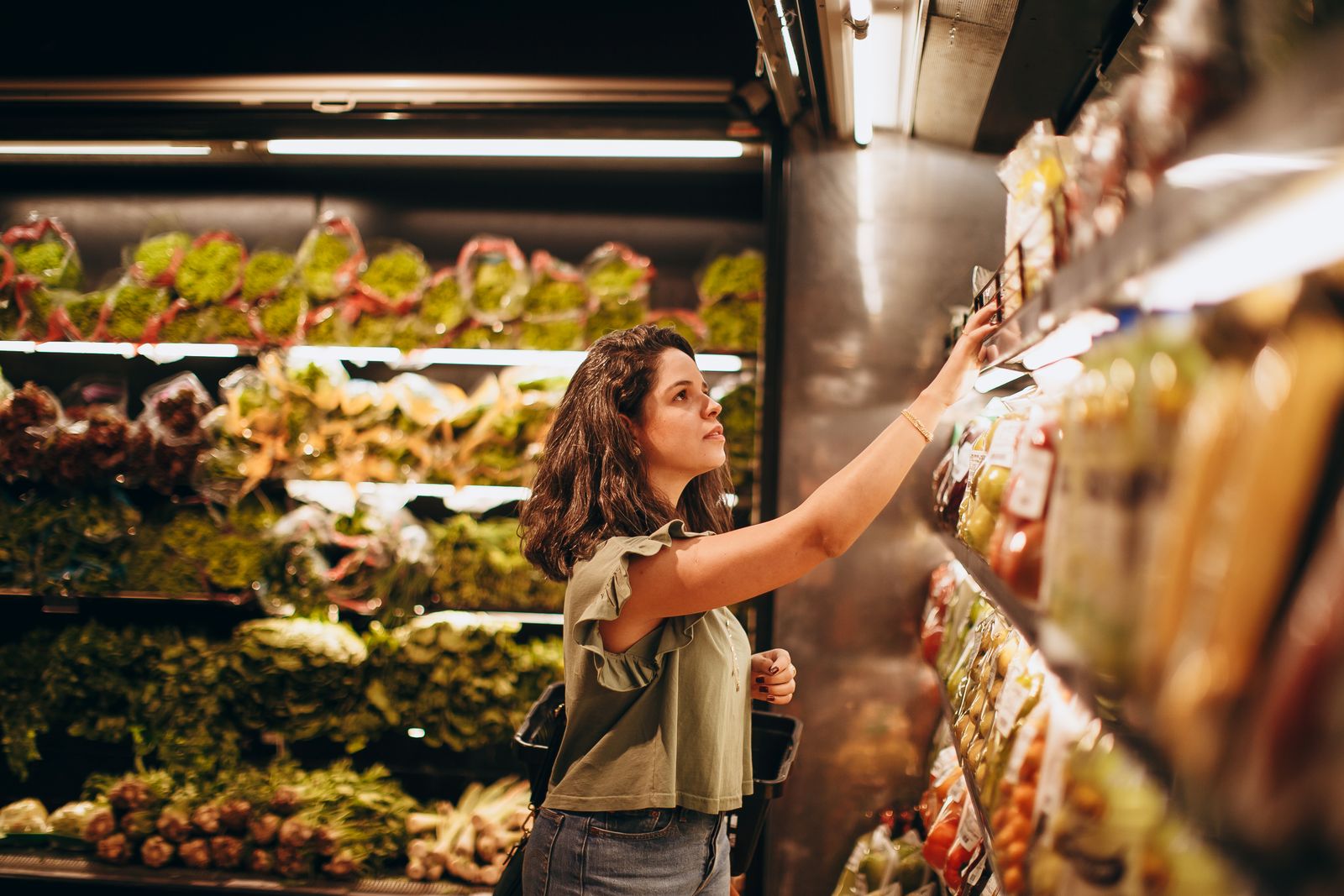
Most of what you eat at home was decided twice before you were hungry: once in the shop, when it went into your cart, and again in the kitchen, when you put it away. Both moments are shaped by the environment around you, and both are easier to change than willpower.
This guide looks at the research on food placement at home and in stores, plus what food labels can and cannot tell you, then turns it into a practical setup for your kitchen and your shopping trips.
In the kitchen: distance and choice
A Cochrane review examined studies that changed how close food was to people or how many options were available [1]. Across 12 studies with more than 1,000 participants, placing food farther away reduced how much people ate, and the effect grew with distance [1]. Offering fewer options also reduced how much of a food people selected, though this was tested in only three small studies [1].
The reviewers rated the certainty of this evidence as low or very low, mainly because most studies were short lab experiments [1]. Still, the direction is consistent, and rearranging a cupboard costs nothing.
In practice, this means your kitchen layout acts as a set of default choices. Whatever is visible and within arm's reach is the easiest thing to eat when you are tired, distracted or stressed. The good news is that the same principle works in your favour once you decide what deserves the prime spots.
In the store: placement and prominence
Supermarkets know this too. Where products sit on the shelf, at the end of aisles or by the checkout is rarely an accident.
A systematic review of 38 studies in stores in high-income countries looked at how product availability and positioning affect diet-related behaviour [2]. The majority of studies found that more prominent placement and greater availability of healthy foods, or less prominent placement of unhealthy foods, went with better dietary behaviour [2]. Many individual results were not statistically significant, and the studies were too varied to combine in a meta-analysis [2].
A second review of 64 studies in US food stores examined strategies such as product changes, pricing, placement and promotion [3]. Of these, 56 reported at least one positive effect on healthier purchasing or consumption [3]. Promotion, such as signs and displays, was the most common strategy, and many interventions combined several approaches at once [3]. However, only 14 were experimental studies with objective outcomes such as sales data, so the authors called for more rigorous research [3].
The message is that store layout influences shoppers, even if the size of the effect varies. You cannot redesign the supermarket, but you can plan around it.
Reading the label: claims, symbols and the "health halo"
Packaging also steers choices. In a randomised online study, 1,997 participants in Canada rated drinks shown with different front-of-pack labels: a warning symbol, a health star rating, traffic-light labels or no label [4].
- All three front-of-pack labels made less healthy drinks look less healthy, which is what they are meant to do [4].
- Health stars and traffic lights also created a "halo" around healthier drinks, making them seem healthier still; warning labels did not [4].
- Drinks carrying a disease risk reduction claim were seen as healthier than the same drinks without it, whether or not the drink was actually healthy [4]. Simpler nutrient content claims did not make a significant difference.
- People who used the Nutrition Facts table were less swayed by front-of-pack labels and claims [4].
The practical lesson: a health claim on the front tells you what the manufacturer wants you to notice. The nutrition panel on the back tells you what is inside.
Setting up your kitchen and cart: a practical plan
These steps apply the research above. They work best as small, gradual changes.
- Make a "front row" for healthy food. Put fruit, washed vegetables, yoghurt and ready-to-eat healthy options at eye level in the fridge and on the counter.
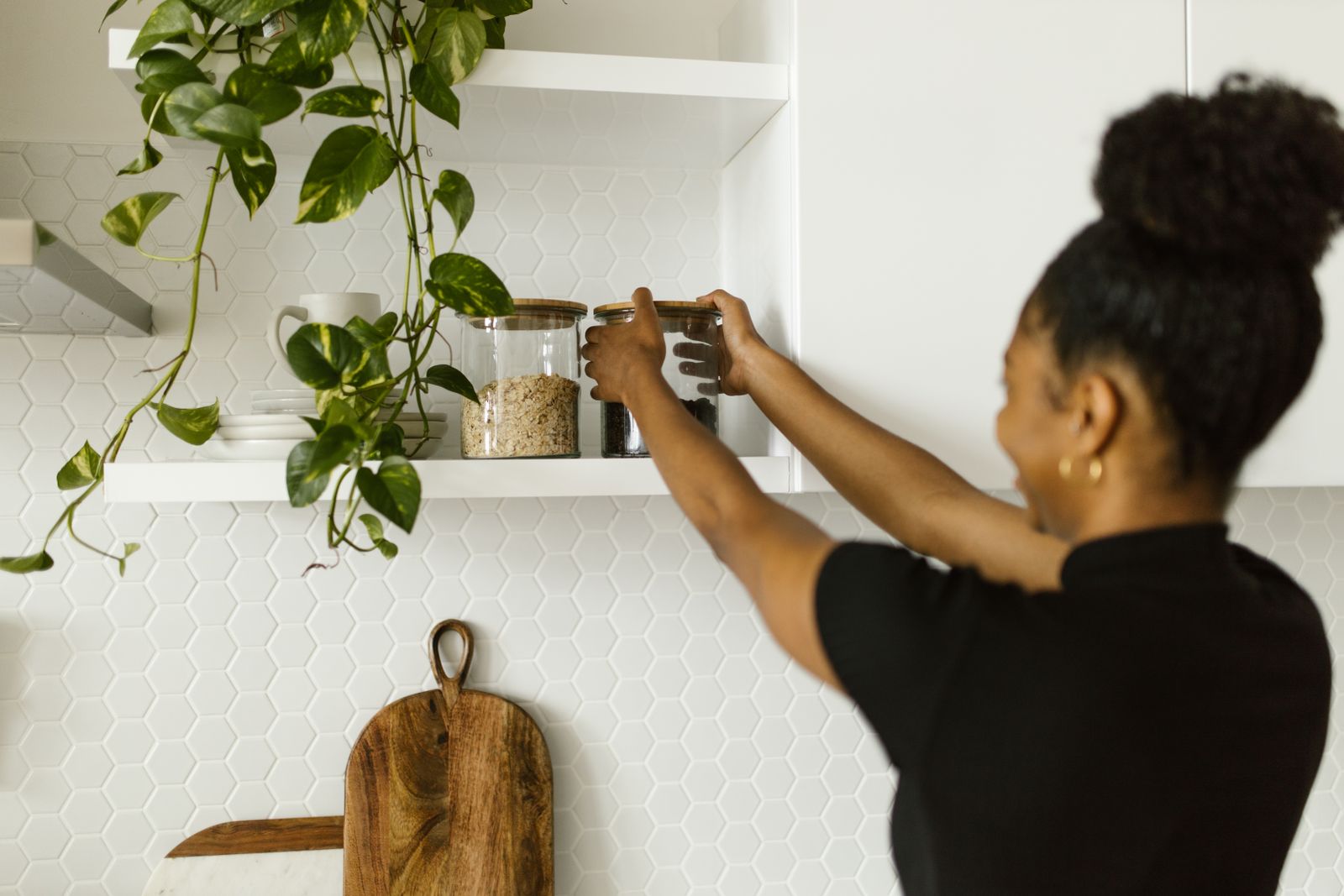
- Move treats out of sight and reach. Use a high shelf, the back of the cupboard or an opaque container. Distance appears to reduce how much is eaten [1].
- Keep fewer options of less healthy foods. One type of snack at home is easier to manage than five [1].
- Shop with a list. Planning meals before you go helps you walk past prominent displays that were not on your plan [2, 3].
- Be wary of end-of-aisle and checkout displays. Prominent placement is designed to catch your eye [2].
- Turn the package over. Check the Nutrition Facts table, not just the claim on the front [4].
- Put shopping away with intention. Store new healthy items at the front and treats at the back as you unpack, so the setup holds.
Practical takeaways
- Placing food farther away tends to reduce how much people eat, though the evidence is low certainty [1].
- In stores, more prominent placement and availability of healthy foods are generally linked to better dietary behaviour [2, 3].
- Front-of-pack labels and health claims shape how healthy a product seems; claims can make even less healthy drinks seem healthier [4].
- The nutrition table is the most reliable guide on the package [4].
Small changes, steady progress
A tidier fridge or a shopping list may seem minor, but repeated every week they shape what you eat. Viivaa helps you build healthy habits one small step at a time, so progress feels steady and sustainable.
This article is for general information only and is not medical or nutritional advice. If you have a medical condition or specific dietary needs, please speak with a doctor or a registered dietitian.
References
- Hollands GJ, Carter P, Anwer S, et al. Altering the availability or proximity of food, alcohol, and tobacco products to change their selection and consumption. Cochrane Database Syst Rev. 2019;8(8):CD012573. https://doi.org/10.1002/14651858.CD012573.pub2
- Shaw SC, Ntani G, Baird J, Vogel CA. A systematic review of the influences of food store product placement on dietary-related outcomes. Nutr Rev. 2020;78(12):1030–1045. https://doi.org/10.1093/nutrit/nuaa024
- Karpyn A, McCallops K, Wolgast H, Glanz K. Improving consumption and purchases of healthier foods in retail environments: a systematic review. Int J Environ Res Public Health. 2020;17(20):7524. https://doi.org/10.3390/ijerph17207524
- Franco-Arellano B, Vanderlee L, Ahmed M, Oh A, L'Abbé M. Influence of front-of-pack labelling and regulated nutrition claims on consumers' perceptions of product healthfulness and purchase intentions: a randomized controlled trial. Appetite. 2020;149:104629. https://doi.org/10.1016/j.appet.2020.104629