
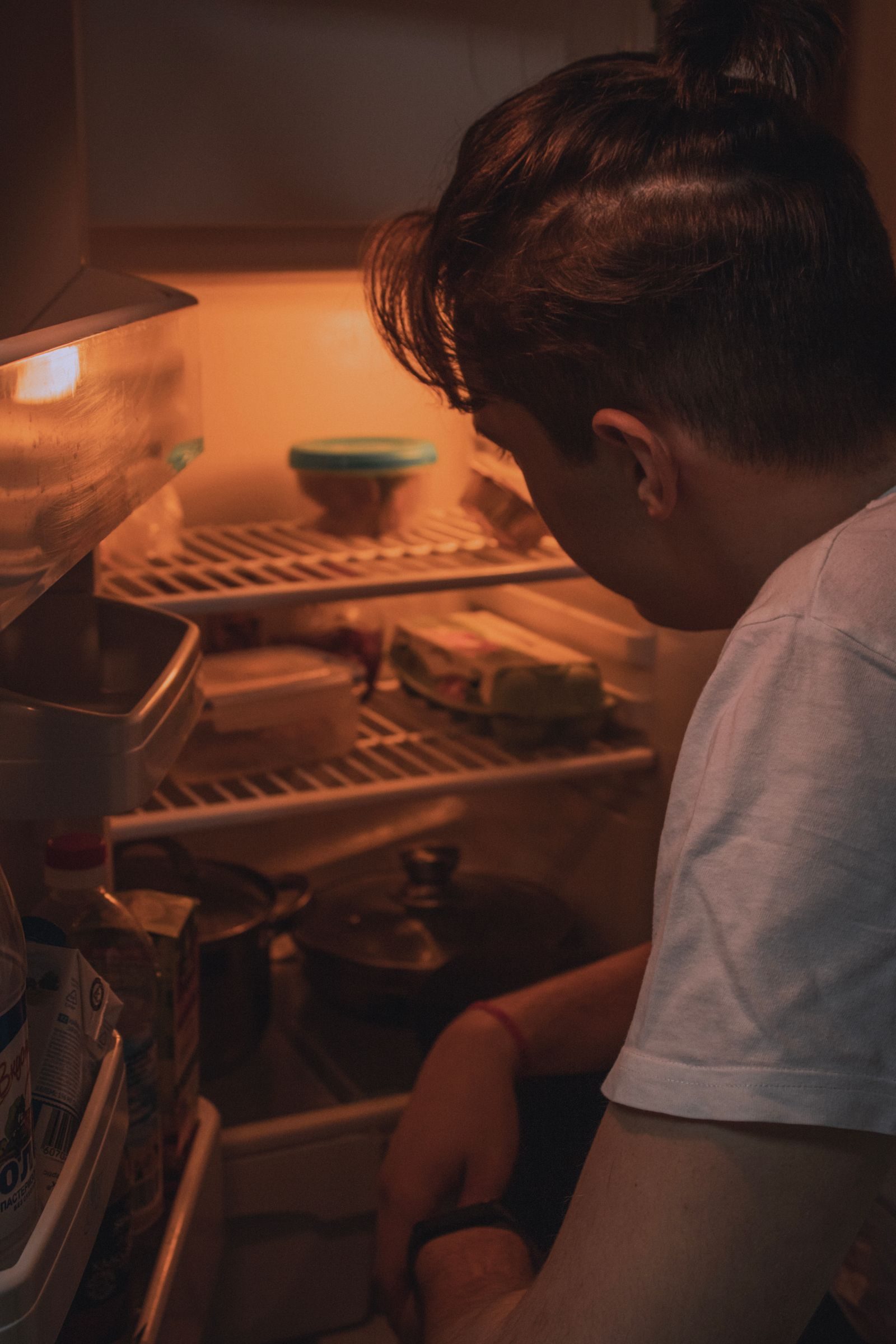
You finished dinner an hour ago. You're not hungry, not really. And yet here you are, standing in front of the open fridge, looking for something.
If that sounds familiar, you're in very good company. Eating when we're not physically hungry is one of the most common experiences there is, and it's rarely about a lack of willpower. Research points to several hidden drivers that can nudge us toward food even when our bodies don't need it.
This is the first article in a three-part series on how we think about food. Here we look at four of those triggers, what the science actually says about each one, and gentle ways to respond.

1. Emotions: eating to cope
"Emotional eating" means eating in response to feelings like stress, sadness, boredom or anxiety, rather than hunger.
A 2023 systematic review and meta-analysis pooled 11 studies with 7,207 adults, all measuring emotional eating with validated questionnaires [1]. Overall, adults with a BMI above the healthy range reported more emotional eating than adults with a healthy BMI. But when the researchers looked more closely, the difference showed up only among adults with obesity. Adults with overweight didn't differ from those with a healthy BMI [1].
The authors concluded that people living with obesity who are seeking help with their weight may benefit from behavioral support for emotional eating [1]. In other words, emotional eating deserves attention and support, not judgment.
What helps: Before eating, try a quick check-in: "What am I feeling right now?" Even naming the emotion ("I'm anxious about tomorrow") creates a small pause between the feeling and the food.
2. Short sleep: when tiredness turns into appetite
Have you ever noticed you snack more after a bad night? There's research behind that.
A 2021 systematic review looked at 50 randomized controlled trials (43 in adults and 7 in children or adolescents) on sleep and eating [2]. Overall, the findings suggested that sleep restriction may lead to significant increases in energy intake, fat intake, body weight, appetite, hunger, eating occasions and portion size [2].
Interestingly, in that review the blood levels of the appetite-related hormones leptin and ghrelin, along with cortisol, weren't influenced by sleep duration [2]. So the "why" may be more complicated than a simple hormone switch. Still, the authors suggested that paying attention to sleep may be an important part of tackling disordered eating [2].
What helps: Treat sleep as part of your eating plan. A consistent bedtime, a wind-down routine and keeping screens out of bed can all support better rest, and possibly fewer late-night fridge visits.
3. Childhood feeding: patterns that start early
How we were fed as children, and how parents respond to children's eating, can shape habits on both sides.
A 2022 systematic review and meta-analysis of 14 longitudinal studies, with 15,348 respondents, examined how parents' "non-responsive" feeding practices and children's eating behaviors influence each other over time [3]. Among the pooled findings [3]:
- Parents using food as a reward predicted more emotional eating in children later on.
- Restrictive feeding by parents predicted greater enjoyment of food in children.
- In the other direction, children who were more responsive to food predicted parents later restricting food or using it as a reward.
An important caveat: the authors described these relationships as inconsistent, with only a minority of the effects they examined reaching statistical significance [3]. So this isn't about blaming parents. It's a reminder that food habits are often learned, and anything learned can be gently relearned.
What helps: If you grew up with "finish your plate" or dessert as a reward, notice when those old rules still show up. As a parent, try offering comfort, praise or time together as rewards instead of treats.
4. Ultra-processed foods: built to be hard to stop
Ultra-processed foods (UPFs) are industrially made products like many packaged snacks, sweets and soft drinks. A 2025 systematic review examined how they might affect two appetite systems [4]:
- Hedonic appetite (eating for pleasure)
- Homeostatic appetite (eating for energy needs)
It included 11 studies: 3 randomized controlled trials, 1 cross-over study, 1 non-randomized controlled study and 6 observational studies [4]. The results indicated that UPFs may influence pleasure-driven eating by promoting faster eating, increasing palatability, activating brain reward circuits and potentially increasing food-addiction behaviors. They may also disrupt the body's fullness signaling through the gut-brain axis and appetite-related hormones such as ghrelin, GLP-1, GIP and PYY [4].
The authors were clear that the findings remain inconclusive because the studies varied so much, but they suggested that reducing UPF consumption could be a relevant target for managing appetite and weight [4].
What helps: You don't need to eliminate every packaged food. Try making it a little easier to choose less processed options: keep fruit on the counter, store snacks out of sight, and plate a portion rather than eating from the bag.
Practical takeaways
- Pause and name it. Ask: "Am I hungry, or am I feeling something?" A few seconds of curiosity can change the outcome.
- Protect your sleep. Research links short sleep with more eating [2], so rest is a genuine health habit.
- Look at your food rules. Notice beliefs you picked up as a child, and keep the ones that serve you.
- Change your surroundings. Make whole foods visible and highly processed snacks a bit less convenient.
- Be kind to yourself. Eating when you're not hungry is human. Shame tends to fuel the cycle; understanding helps break it.
- Get support if you need it. If emotional eating feels overwhelming, a doctor, dietitian or therapist can help.
Building habits that last
Noticing your triggers is a powerful first step, and small, consistent habits help you respond differently over time. Viivaa helps you build these everyday habits one step at a time, so changing your relationship with food feels doable.
This article is for general information only and isn't medical advice. If you're struggling with your eating or think you may have an eating disorder, please talk to your doctor or another qualified health professional.
References
- Vasileiou V, Abbott S. Emotional eating among adults with healthy weight, overweight and obesity: a systematic review and meta-analysis. J Hum Nutr Diet. 2023;36(5):1922–1930. https://doi.org/10.1111/jhn.13176
- Soltanieh S, Solgi S, Ansari M, Santos HO, Abbasi B. Effect of sleep duration on dietary intake, desire to eat, measures of food intake and metabolic hormones: a systematic review of clinical trials. Clin Nutr ESPEN. 2021;45:55–65. https://doi.org/10.1016/j.clnesp.2021.07.029
- Wang J, Zhu B, Wu R, Chang YS, Cao Y, Zhu D. Bidirectional associations between parental non-responsive feeding practices and child eating behaviors: a systematic review and meta-analysis of longitudinal prospective studies. Nutrients. 2022;14(9):1896. https://doi.org/10.3390/nu14091896
- Ulug E, Acikgoz Pinar A, Yildiz BO. Impact of ultra-processed foods on hedonic and homeostatic appetite regulation: a systematic review. Appetite. 2025;213:108139. https://doi.org/10.1016/j.appet.2025.108139