
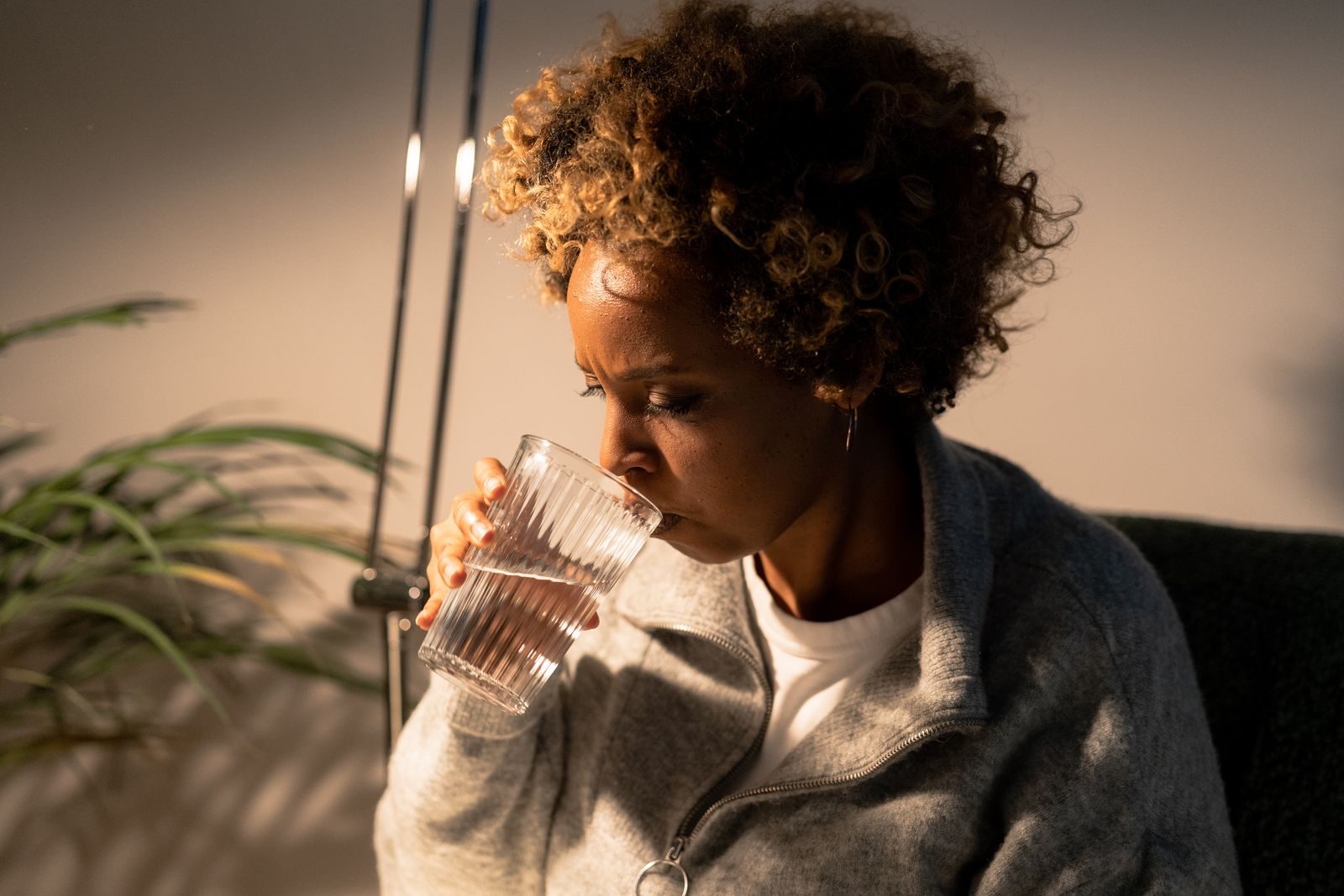
"Drink eight glasses of water a day." It's one of the most repeated pieces of health advice out there. It's printed on water bottles, shared in wellness posts and passed between friends.
But where does it come from, and is it actually true? The answer is more interesting, and more relaxed, than you might expect. In this first part of our hydration series, we look at what official guidelines say, where the "8 glasses" rule came from, and how you can tell if you're getting enough.
What official guidelines say
One widely cited reference is a report by the US Institute of Medicine (now part of the National Academies), which sets the values used in the US and Canada [1]. Health authorities in other countries publish their own figures. Rather than setting a strict requirement, it set Adequate Intakes based on how much healthy, well-hydrated people typically consume [1][2]:
- About 2.7 liters (91 ounces) of total water a day for women
- About 3.7 liters (125 ounces) a day for men
The key word is total. That includes water from all drinks and food. About 80% of people's total water comes from drinking water and other beverages, including caffeinated ones, and the other 20% comes from food [2].
The report's panel also said that the vast majority of healthy people meet their daily needs by letting thirst be their guide [2]. People who are very active or live in hot climates may need more [2].
Water from food counts

This is easy to forget. Fruits like watermelon and oranges, vegetables like cucumber and lettuce, and dishes like soup all contribute. So do milk, tea and coffee. When the panel that wrote the report said it didn't offer a rule of thumb for how many glasses to drink, it explained that hydration needs can be met through many sources besides plain water [2].
Is there one "right" daily amount?
Not really, and scientists are still debating how best to define it.
A 2018 review in Nutrients pointed out that there is no widespread consensus on human water requirements for different groups, because the body's water-regulation system is complex and people differ a lot from one another [3]. The authors proposed using the body's own hormonal response, specifically arginine vasopressin (the hormone that tells your kidneys to hold on to water), as a marker. Using published data, they estimated that the body starts a mild defense of its water when total water intake falls below about 1.8 liters (about 61 ounces) a day, and that 19% to 71% of adults in various countries drink less than that [3].
That's one research team's proposed approach, not an official guideline, and it's worth knowing that the authors disclosed past funding or consulting ties with Danone Nutricia Research and the Drinking Water Research Foundation [3]. Still, it's a useful reminder that "enough" varies from person to person.
Where did "8 glasses a day" come from?
A physiologist at Dartmouth Medical School went looking for the origins of the "8 × 8" rule (eight 8-ounce glasses, roughly 240 ml each) in a 2002 review [4]. The result: no scientific studies were found to support it [4].
He suggested one possible origin [4][5]. An old recommendation from the US Food and Nutrition Board advised roughly 1 milliliter of water for each calorie of food, about 2 to 2.5 quarts a day. But the very next sentence said that most of this quantity is already contained in prepared foods. That second part, he suggested, may have been missed [5].
The review also concluded that caffeinated drinks can count toward your daily total [4]. Importantly, it noted that larger intakes are advisable in some situations, such as certain medical conditions and vigorous work or exercise, especially in hot climates [4].
Can you trust urine color?
Checking the color of your urine is one of the easiest at-home hydration checks. But does it work?
A 2021 systematic review screened 424 articles and found 10 that tested urine color against lab measures of hydration [6]. Most found significant associations, with correlations ranging from 0.40 to 0.93, and urine color generally showed a high sensitivity for detecting dehydration [6]. However, correlations were lower in adults over 60 [6]. The authors added that more research is needed on how well people use the method in real life [6].
So pale-yellow urine is a reasonable everyday signal for most adults, but it's not perfect, and it may be less reliable as we get older.
Older adults need extra attention
A 2023 review on hydration in older adults found that many don't maintain adequate hydration, and that this is often under-recognized [7]. Older adults are more vulnerable to dehydration, especially those living with several chronic conditions, and dehydration is linked with longer hospital stays, readmissions and poorer outcomes [7].
If you care for an older parent or relative, gently offering drinks and water-rich foods throughout the day can help.
Even mild dehydration can affect how you feel
You don't need to be severely dehydrated to notice a difference. In a small, controlled study of 25 healthy young women, mild dehydration of about 1.36% of body mass (brought on by exercise, with or without a diuretic) led to worse mood, lower concentration, a greater sense that tasks were difficult, and headache [8]. Most aspects of cognitive performance weren't affected [8].
It's a small study in a specific group, but it suggests that feeling foggy or irritable on a busy day might sometimes be your body asking for a drink.
Practical takeaways
- Think "total water," not just glasses. Drinks and food both count [2].
- Let thirst guide you most days. That's how most healthy people meet their needs [2].
- Drink more when it's hot or you're active. Needs rise with heat and exercise [2][4].
- Use urine color as a rough check. Pale yellow is a good sign, but it's less reliable after 60 [6].
- Look out for older loved ones. They're more vulnerable to dehydration [7].
- Notice how you feel. Headache and low concentration can be early clues [8].
- Ask your doctor about your number. If you have heart, kidney or other conditions, your fluid needs may be different.
Building habits that last
Hydration is one of the simplest habits to build, and one of the easiest to forget. Viivaa helps you build these everyday habits one small step at a time, so they feel natural and sustainable.
This article is for general information only and isn't medical advice. If you have a heart, kidney or other medical condition, or take medications that affect fluid balance, please ask your doctor how much you should drink.
References
- Institute of Medicine. Dietary Reference Intakes for Water, Potassium, Sodium, Chloride, and Sulfate. Washington, DC: The National Academies Press; 2005. https://doi.org/10.17226/10925
- National Academies. Report sets dietary intake levels for water, salt, and potassium to maintain health and reduce chronic disease risk [news release]. February 11, 2004. https://www.nationalacademies.org/news/report-sets-dietary-intake-levels-for-water-salt-and-potassium-to-maintain-health-and-reduce-chronic-disease-risk
- Armstrong LE, Johnson EC. Water intake, water balance, and the elusive daily water requirement. Nutrients. 2018;10(12):1928. https://doi.org/10.3390/nu10121928
- Valtin H. "Drink at least eight glasses of water a day." Really? Is there scientific evidence for "8 × 8"? Am J Physiol Regul Integr Comp Physiol. 2002;283(5):R993–R1004. https://doi.org/10.1152/ajpregu.00365.2002
- Dartmouth Medical School. "Drink at least 8 glasses of water a day" – really? [news release]. August 8, 2002. https://geiselmed.dartmouth.edu/news/2002_h2/08aug2002_water.shtml
- Kostelnik SB, Davy KP, Hedrick VE, Thomas DT, Davy BM. The validity of urine color as a hydration biomarker within the general adult population and athletes: a systematic review. J Am Coll Nutr. 2021;40(2):172–179. https://doi.org/10.1080/07315724.2020.1750073
- Li S, Xiao X, Zhang X. Hydration status in older adults: current knowledge and future challenges. Nutrients. 2023;15(11):2609. https://doi.org/10.3390/nu15112609
- Armstrong LE, Ganio MS, Casa DJ, et al. Mild dehydration affects mood in healthy young women. J Nutr. 2012;142(2):382–388. https://doi.org/10.3945/jn.111.142000