
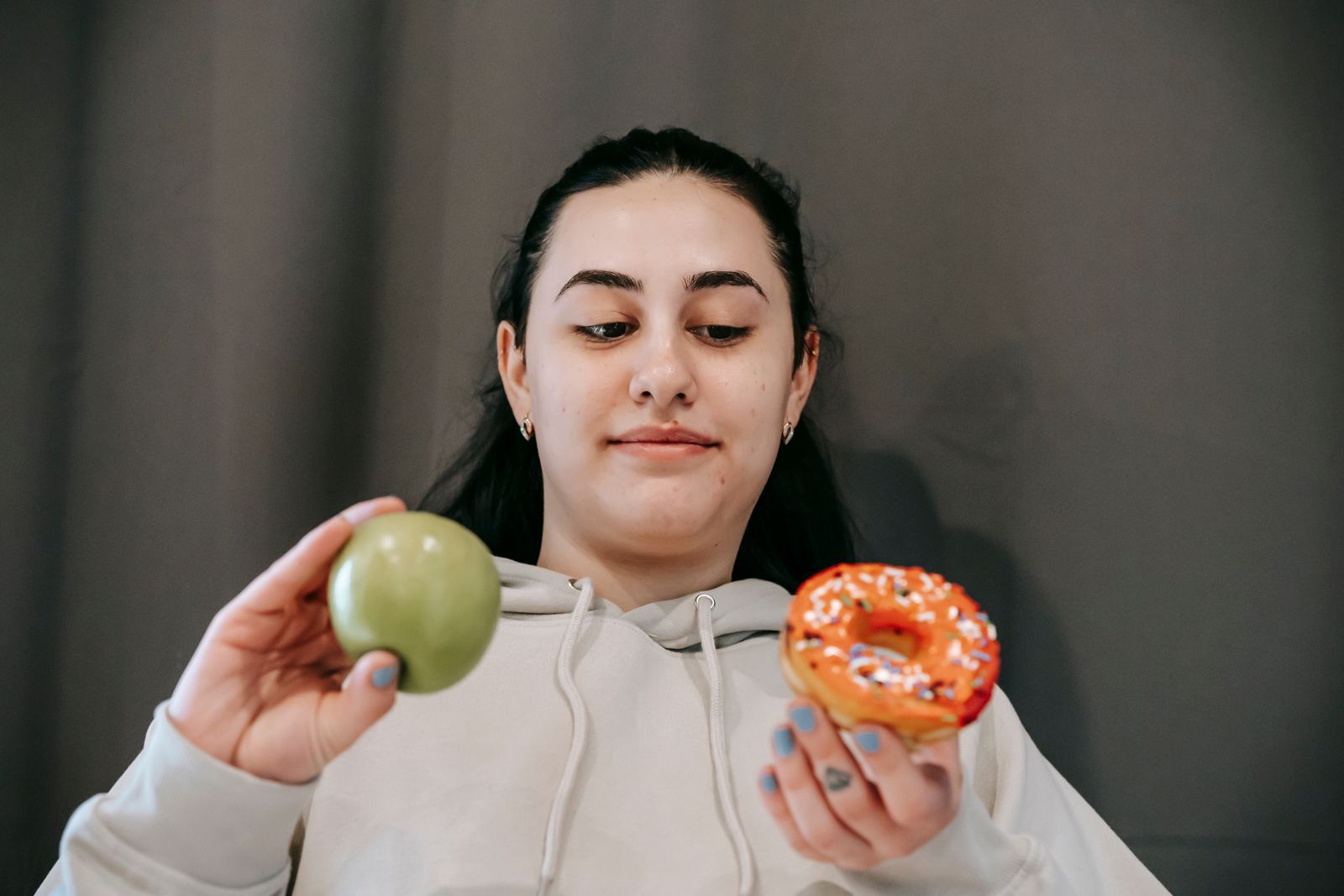
"I just don't have any willpower." It's one of the most common things people say about food, and one of the least helpful. It treats self-control as something you're born with or without.
Research suggests a more hopeful picture. The mental skills behind food choices can be trained, and how we think about the future can shift what we choose today. Here's what the evidence shows, and why your future self includes your muscles and bones.
Self-control is partly a skill
Psychologists call the ability to stop or hold back an action inhibitory control. It's what lets you pause before reaching for a second helping, or put a packet back on the shelf.
A 2013 review of training studies found that inhibitory control can improve with practice in two ways [1]. One is by strengthening deliberate, "top-down" control, the effortful kind of stopping. The other is by making inhibition more automatic. When the same cue is repeatedly paired with stopping, the cue itself starts to trigger the brake, bypassing slower, effortful control [1].
By contrast, training that keeps changing which cues require stopping, or that involves frequent failures, tends to strengthen effortful top-down control rather than building automatic stopping [1].
That second, automatic route is interesting for eating. If we repeatedly practise pausing in the same situations, stopping may gradually take less effort. For everyday life, the lesson is consistency: the same situation, the same pause, repeated until it becomes familiar.
Can you train self-control around food?
Researchers have tested this with inhibitory control training: simple computer tasks in which people learn to hold back a response whenever they see pictures of tempting foods (or alcohol), and respond freely to other images.
A 2016 meta-analysis pooled 18 results from 14 laboratory studies [2]. People who completed this training went on to choose or consume significantly less of the tempting food or alcohol than control groups. The effect was small to moderate (standardised mean difference 0.36) [2]. A few details stood out:
- Tasks that required physically stopping a movement (such as "go/no-go" and "stop-signal" tasks) worked better than tasks based on eye movements.
- Effects on food intake were greater in people who were already trying to limit what they ate.
- What mattered was successful stopping: the more often people managed to inhibit their response, the larger the effect, while the total number of trials didn't predict results [2].
There's an important caveat. These were mostly short-term laboratory studies, and the authors highlighted the need for research outside the lab [2]. Inhibitory control training is promising, not proven as a long-term weight strategy.
Picturing the future changes today's choices
Many food decisions are trade-offs between now and later: the pleasure of a snack now versus the health benefits of a different choice later. People tend to discount future rewards, valuing them less the further away they are. This tendency, called delay discounting, tends to be higher in people with obesity or binge eating symptoms [3].
Episodic future thinking is a simple technique to counter it. You vividly imagine specific, positive future events, such as a holiday next summer, playing with grandchildren or walking a hill with ease, and bring those images to mind when making decisions.
A 2024 meta-analysis of 12 studies with 951 adults with overweight or obesity found that episodic future thinking [3]:
- reduced delay discounting, with a medium effect (g = 0.55), and
- improved subsequent food choices, with a small effect (g = 0.31).
Imagining more distant futures was linked to bigger improvements in real food and eating choices [3]. The takeaway: the future you picture shapes the choice you make now.

Your future self needs muscle
When people picture a healthier future, they often think about weight. Muscle deserves a place in that picture too.
A 2023 meta-analysis of 49 prospective studies, following 878,349 people for 2.5 to 32 years, found that low muscle mass ("muscle wasting") was associated with a 36% higher risk of death from any cause, as well as higher risks of death from cardiovascular disease, cancer and respiratory disease [4]. These are observational findings, so they show an association rather than proof of cause, but the pattern was consistent, and the link held regardless of muscle strength [4].
The encouraging part is that muscle and bone respond to training at any age. A 2022 meta-analysis of 14 randomised trials in adults aged 65 and over found that progressive resistance training (gradually increasing the load over time) increased lower-body muscle strength and bone mineral density at the hip, though not at the lumbar spine [5]. Training more often favoured gains in both strength and bone density together, and combining resistance work with weight-bearing exercise favoured bone density gains [5].
This connects back to future thinking. Strength training rarely feels rewarding in the first week; its payoff arrives months and years later. Picturing that future, carrying shopping up the stairs or getting up from the floor easily, can make today's session feel more worthwhile.
In other words, the choices you make today about movement and protein are an investment in the body you'll be living in decades from now.
Practical takeaways
- Treat self-control as a skill you can practise, not a trait you lack.
- Choose one or two predictable "pause points", such as opening the fridge after dinner, and practise stopping there consistently.
- Count successful pauses, not perfect days; success is what seems to build the habit.
- Before a tricky food decision, spend a minute vividly imagining a specific, positive event in your future.
- Include progressive strength training in your week; it protects muscle and bone as you age.
- Be kind to yourself on harder days; one choice doesn't define you.
Building habits that last
Small, repeated actions are how skills are built. Viivaa helps you build these healthy habits one small step at a time, so progress feels steady and sustainable.
This article is for general information only and isn't medical advice. If you're living with binge eating or another eating difficulty, or have a health condition that affects exercise, please talk to your doctor or a qualified health professional before making changes.
References
- Spierer L, Chavan CF, Manuel AL. Training-induced behavioral and brain plasticity in inhibitory control. Front Hum Neurosci. 2013;7:427. https://doi.org/10.3389/fnhum.2013.00427
- Jones A, Di Lemma LC, Robinson E, et al. Inhibitory control training for appetitive behaviour change: a meta-analytic investigation of mechanisms of action and moderators of effectiveness. Appetite. 2016;97:16–28. https://doi.org/10.1016/j.appet.2015.11.013
- Colton E, Connors M, Mahlberg J, Verdejo-Garcia A. Episodic future thinking improves intertemporal choice and food choice in individuals with higher weight: a systematic review and meta-analysis. Obes Rev. 2024;25(10):e13801. https://doi.org/10.1111/obr.13801
- Zhou HH, Liao Y, Peng Z, Liu F, Wang Q, Yang W. Association of muscle wasting with mortality risk among adults: a systematic review and meta-analysis of prospective studies. J Cachexia Sarcopenia Muscle. 2023;14(4):1596–1612. https://doi.org/10.1002/jcsm.13263
- O'Bryan SJ, Giuliano C, Woessner MN, et al. Progressive resistance training for concomitant increases in muscle strength and bone mineral density in older adults: a systematic review and meta-analysis. Sports Med. 2022;52(8):1939–1960. https://doi.org/10.1007/s40279-022-01675-2