

Think about the last time you finished everything on your plate. Was it because you were still hungry, or because that's how much was there? For most of us, the honest answer is often the second.
Researchers call this the portion size effect: when we're served more food, we eat more. It's one of the most consistent findings in nutrition research. The good news is that the same effect can work in your favour.
The portion size effect, in numbers
The portion size effect has been tested in dozens of controlled studies. A 2022 meta-analysis pooled randomised controlled feeding trials in healthy adults [1]. When people were served larger portions, their daily energy intake was on average 295 kcal higher. The trials varied a lot, and there weren't enough long-term studies to measure the effect on body weight directly [1].
It doesn't wear off after a day or two
You might expect the body to notice the extra food and eat less later to make up for it. One study tested this carefully [2]. Twenty-three adults, some with a healthy weight and some with overweight, had all their food and drinks provided for two separate 11-day periods. In one period, they received standard portions; in the other, every portion was 50% larger.
With bigger portions, participants ate an average of 423 kcal more per day. This didn't fade over the 11 days, adding up to around 4,636 extra kcal in total [2]. The effect was seen at every meal and in almost every type of food. The exceptions are interesting: fruit served as a snack and vegetables [2]. The effect was similar regardless of participants' body weight.
Knowing the portion is large doesn't protect us
Maybe we eat more simply because we don't realise how big the portion is? Researchers tested whether giving people clear information about portion size would change anything [3]. Participants were served a small or large lunch of pasta, with or without cues that showed how big it was.
The portion size effect held either way [3]. What explained it was people's sense of how much is appropriate to eat. A bigger plate of food quietly resets what feels like a "normal" amount. The authors suggest that changing these consumption norms may be a useful way to support healthier choices [3].
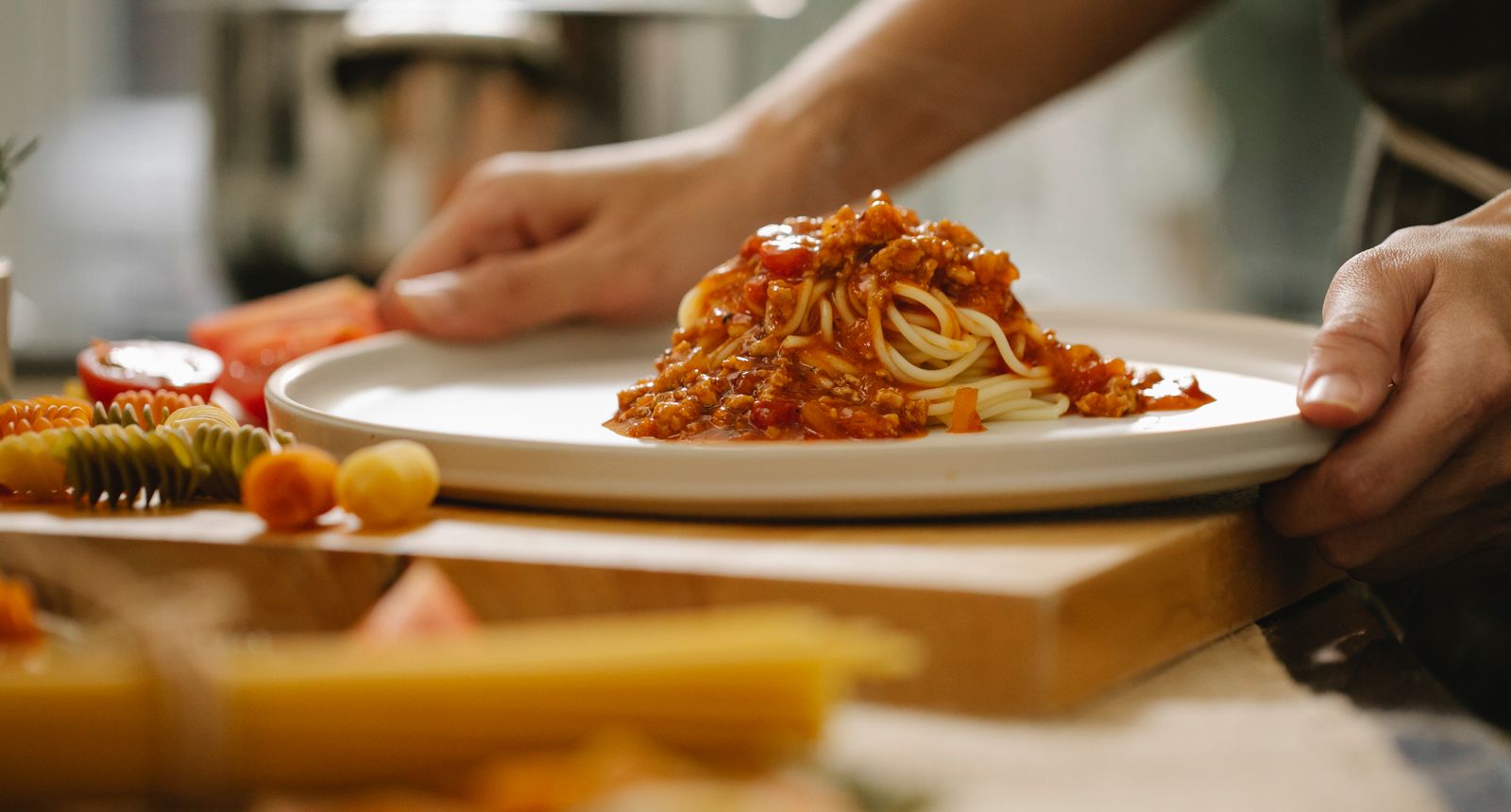
What happens when portions are made smaller?
If bigger portions push intake up, can smaller portions bring it down? A 2023 meta-analysis looked at 14 studies in which researchers reduced the size of food portions served and measured intake for at least a full day [4].
The findings [4]:
- Being served smaller rather than larger portions reduced daily energy intake by about 235 kcal.
- Bigger reductions in portion size led to bigger drops in daily intake.
- The relationship wasn't a straight line. Reducing a portion from very large to large had less effect than reducing from large to moderate.
- In the four studies that measured body weight, people served smaller portions gained about 0.58 kg less than those served larger ones.
The authors concluded that reducing portion sizes may be an effective way to help prevent weight gain at a population level [4]. Importantly, people in these studies weren't asked to "try harder". The environment did much of the work.
How to use the portion size effect at home
Since portion size shapes intake largely without our awareness, it makes sense to set up your environment so that the default is a moderate amount:
- Serve from the kitchen, not the table. Put a reasonable portion on your plate and leave the serving dishes out of reach.
- Use smaller plates and bowls for energy-dense foods, such as pasta, rice, desserts and snacks.
- Go bigger on vegetables and fruit. In the 11-day study, larger portions of vegetables and fruit as a snack didn't drive the same overeating as other foods [2]. Let them take up more of the plate.
- Portion out snacks. Pour a serving into a bowl instead of eating straight from the packet.
- Order or share smartly. When eating out, consider a starter-sized dish, sharing a main course, or packing half to take home.
- Reset your sense of "normal". Since our idea of an appropriate amount drives the effect [3], it helps to learn what a typical portion looks like, for example using your hand or a measuring cup a few times.
- Pause before seconds. Give yourself a few minutes before deciding whether you're still hungry.
None of this means you have to eat tiny meals or go hungry. It's about letting the setting help you, instead of working against you.
Practical takeaways
- Larger portions led to about 295 kcal more per day in controlled trials [1].
- With 50% bigger portions, people ate 423 kcal more per day, and the effect lasted 11 days without fading [2].
- Knowing a portion is large doesn't stop us eating more; our sense of a "normal" amount drives the effect [3].
- Smaller portions reduced intake by about 235 kcal per day and were linked with less weight gain [4].
- Simple changes to how food is served at home can make the portion size effect work for you.
Let your environment do the work
Small changes to how you serve food can add up over time. Viivaa helps you build healthy habits one small step at a time, so progress feels steady and sustainable.
This article is for general information only and isn't medical advice. If you have specific nutritional needs, a medical condition or a history of disordered eating, please talk to your doctor or a registered dietitian before changing how much you eat.
References
- Higgins KA, Hudson JL, Hayes AMR, et al. Systematic review and meta-analysis on the effect of portion size and ingestive frequency on energy intake and body weight among adults in randomized controlled feeding trials. Adv Nutr. 2022;13(1):248–268. https://doi.org/10.1093/advances/nmab112
- Rolls BJ, Roe LS, Meengs JS. The effect of large portion sizes on energy intake is sustained for 11 days. Obesity (Silver Spring). 2007;15(6):1535–1543. https://doi.org/10.1038/oby.2007.182
- Reily NM, Vartanian LR. The portion size effect on food intake is robust to contextual size information. Appetite. 2016;105:439–448. https://doi.org/10.1016/j.appet.2016.06.015
- Robinson E, McFarland-Lesser I, Patel Z, Jones A. Downsizing food: a systematic review and meta-analysis examining the effect of reducing served food portion sizes on daily energy intake and body weight. Br J Nutr. 2023;129(5):888–903. https://doi.org/10.1017/S0007114522000903