
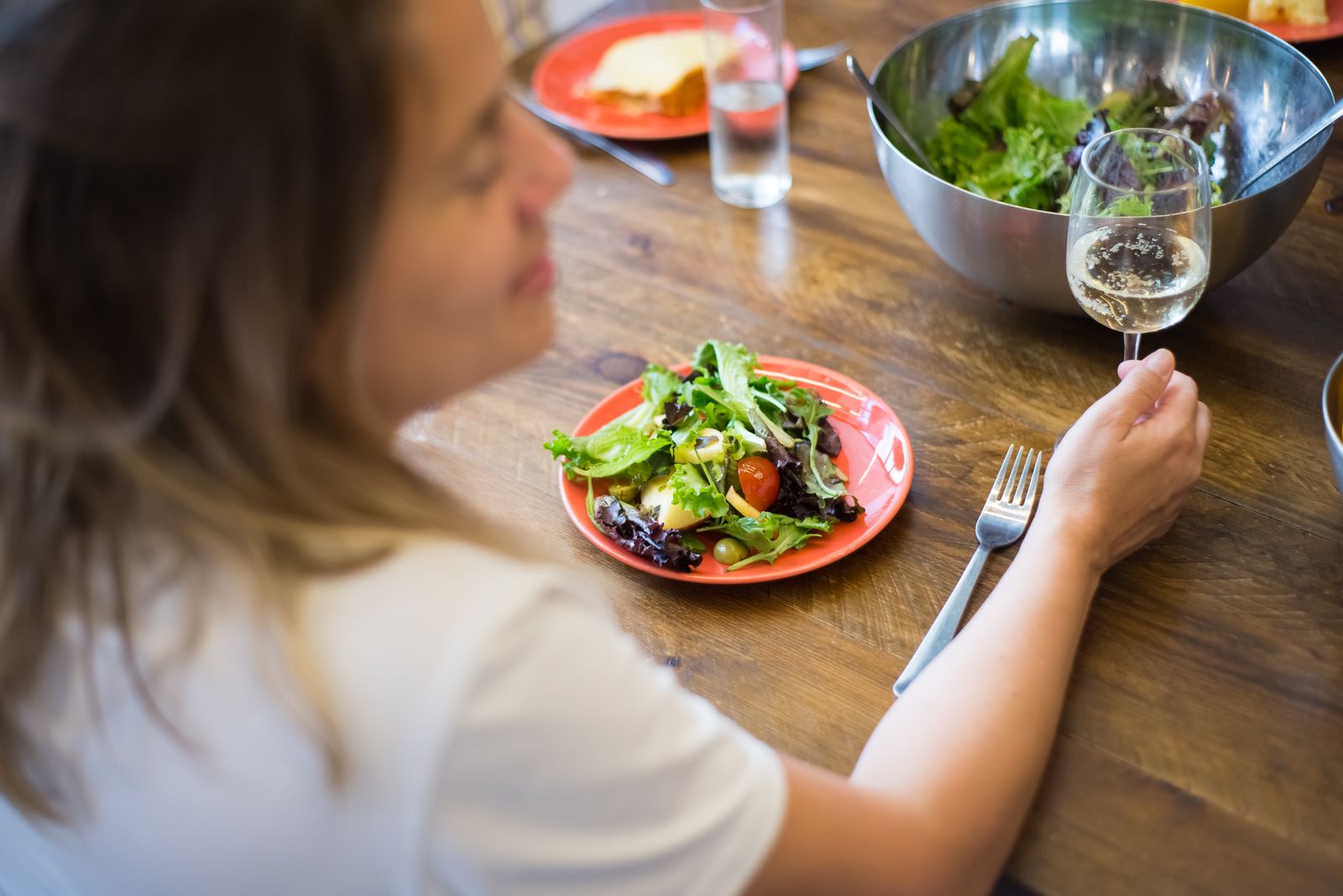
"Slow down and chew your food" sounds like advice from a grandparent. It turns out there's real physiology behind it. How big your bites are, how long you chew and how fast you eat all influence how much food it takes before you feel satisfied.
This article explains what controlled studies show about eating speed, how your gut and brain communicate fullness, and how to turn that into simple habits at the table.
Fullness isn't instant
Feeling full is not a single switch. It's built from several signals that arrive over time. As food reaches the stomach, it stretches the stomach wall. As nutrients reach the small intestine, specialised cells release hormones that travel to the brain and nerves that relay messages along the gut-brain axis [1].
Researchers distinguish two related ideas. Satiation is the process that brings a meal to an end. Satiety is the feeling of fullness that keeps you from eating again for a while. Gut signals contribute to both [1,2].
Because these signals take time to build, eating very quickly can mean finishing a large amount of food before your body has had a chance to say "enough".
The gut hormones behind fullness
Several hormones released by the gut after eating reduce food intake. Reviews highlight GLP-1 (glucagon-like peptide-1), PYY, oxyntomodulin and pancreatic polypeptide, which reduce food intake in both animals and humans and are thought to act as "meal terminators" [2]. CCK (cholecystokinin), released when fat and protein reach the small intestine, is another key satiation signal [1].
On the other side is ghrelin, made mainly in the stomach, which rises before meals and stimulates appetite [1].
Is CCK really a fullness hormone in humans, or just a lab curiosity? A small 1994 experiment helps answer that. Six healthy volunteers took an amino acid that strongly releases CCK 20 minutes before a meal [3]. Their CCK levels rose about fivefold, from 1.10 to 5.49 pmol/L. They then ate about 1,089 kcal on average, compared with 1,587 kcal after a placebo, and reported feeling fuller [3]. This study used a supplement, not slower eating, but it shows that the body's own CCK can meaningfully reduce how much people eat.
Smaller bites, longer chewing, less food
So what does the way we eat have to do with these signals? A Dutch trial tested bite size and chewing time directly [4]. Twenty-two healthy adults ate chocolate custard until they felt satisfied, under different conditions. Bites were either small (about 5 g) or large (about 15 g), and each mouthful was held in the mouth for either 3 or 9 seconds.
Bite size had a strong effect [4]:
- With small bites, people ate 382 g with 3-second processing and 313 g with 9-second processing.
- With large bites, they ate 476 g and 432 g respectively.
Smaller bites and longer time in the mouth both led to people eating less before feeling satisfied. The authors concluded that more "oral sensory exposure" to a food reduces intake [4].
A broader review from the same research field adds that harder, chunkier foods naturally slow eating and that, across studies, slowing eating rate by about 20% can reduce intake by roughly 1% to 14% without people feeling less satisfied afterwards [5].
What about chewing 30 times per bite?
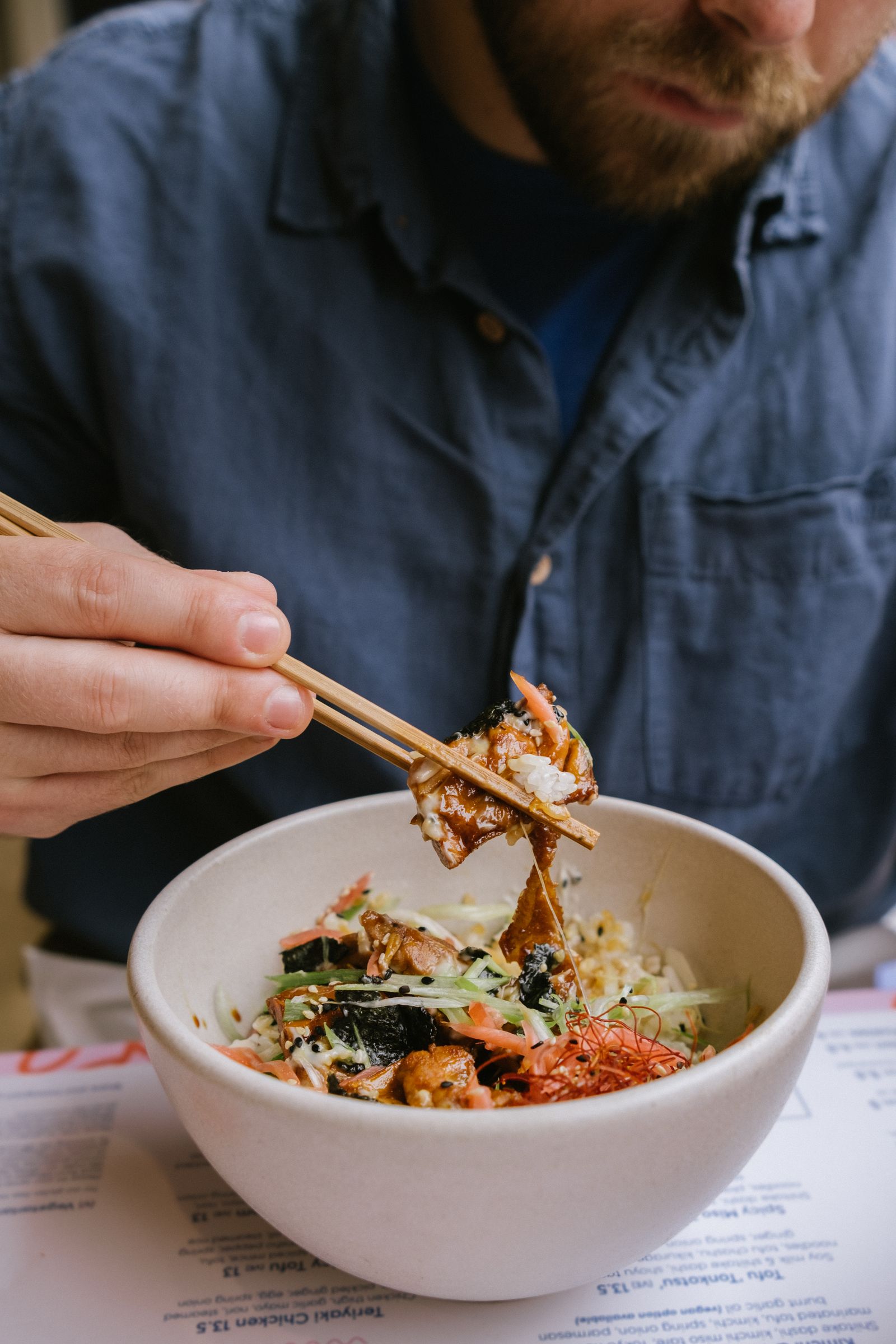
You may have heard the advice to chew every mouthful 30 times. A Japanese pilot study actually tested it [6]. Young healthy volunteers ate the same test meal in different ways: their usual way, chewing on one side only, eating quickly, or chewing 30 times per bite. There were 10 people in each group.
Only chewing 30 times per bite increased blood levels of active GLP-1. Eating quickly or chewing on one side did not [6]. Blood sugar and insulin didn't change. However, when the same method was tested in 15 people with type 2 diabetes, it made no difference to GLP-1 [6].
The authors themselves describe it as a small pilot trial. It's an interesting signal, not proof that chewing a set number of times will lead to weight loss.
Putting it into practice
You don't need to count every chew. These habits are consistent with the evidence:
- Take smaller bites. Use a smaller spoon or fork, and cut food into smaller pieces.
- Put your cutlery down between bites. It's a simple way to slow your pace.
- Choose foods that need chewing. Whole fruit, vegetables, whole grains and foods with texture naturally slow you down [5].
- Give fullness time to arrive. Pause partway through the meal and check in with how hungry you still feel.
- Reduce distractions. Eating in front of a screen makes it easier to eat fast without noticing.
- Be kind to yourself. Eating speed is a habit. It changes gradually with practice.
Practical takeaways
- Fullness is built over time by stomach stretch and gut hormones such as GLP-1, PYY and CCK [1,2].
- Smaller bites and longer chewing led people to eat less of the same food before feeling satisfied [4].
- Slowing eating rate by about 20% has been linked with eating roughly 1% to 14% less, without less satisfaction [5].
- Chewing 30 times per bite raised GLP-1 in a small pilot study in healthy adults, but not in people with type 2 diabetes [6].
- Practical changes like smaller bites and fewer distractions are easy, low-risk ways to start.
A calmer way to eat
Slowing down is one of the simplest habits you can practise at every meal. Viivaa helps you build healthy habits one small step at a time, so progress feels steady and sustainable.
This article is for general information only and isn't medical advice. If you have difficulty chewing or swallowing, a digestive condition or diabetes, please talk to your doctor or a registered dietitian before changing how you eat.
References
- Cummings DE, Overduin J. Gastrointestinal regulation of food intake. J Clin Invest. 2007;117(1):13–23. https://doi.org/10.1172/JCI30227
- Chaudhri OB, Salem V, Murphy KG, Bloom SR. Gastrointestinal satiety signals. Annu Rev Physiol. 2008;70:239–255. https://doi.org/10.1146/annurev.physiol.70.113006.100506
- Ballinger AB, Clark ML. L-phenylalanine releases cholecystokinin (CCK) and is associated with reduced food intake in humans: evidence for a physiological role of CCK in control of eating. Metabolism. 1994;43(6):735–738. https://doi.org/10.1016/0026-0495(94)90123-6
- Zijlstra N, de Wijk RA, Mars M, Stafleu A, de Graaf C. Effect of bite size and oral processing time of a semisolid food on satiation. Am J Clin Nutr. 2009;90(2):269–275. https://doi.org/10.3945/ajcn.2009.27694
- Forde CG, de Graaf K. Influence of sensory properties in moderating eating behaviors and food intake. Front Nutr. 2022;9:841444. https://doi.org/10.3389/fnut.2022.841444
- Sonoki K, Iwase M, Takata Y, et al. Effects of thirty-times chewing per bite on secretion of glucagon-like peptide-1 in healthy volunteers and type 2 diabetic patients. Endocr J. 2013;60(3):311–319. https://doi.org/10.1507/endocrj.EJ12-0310